

Pearlish3 min read
Akoya and freshwater are the two pearls you will see most often in Japan. Both are real, cultured pearls. Different animals grow them in different ways, so the two look and wear differently.
Key takeaways
- Akoya pearls grow in saltwater oysters in western Japan. Freshwater pearls grow in mussels and are almost solid nacre.
- Akoya pearls are rounder, shinier and cost more. Freshwater pearls have a softer glow, more shapes and colors, and better value.
- For funerals and formal events, a white Akoya strand is the classic choice. For everyday wear, choose freshwater.
Contents
Where they come from
Akoya pearls grow in the Akoya pearl oyster, a saltwater oyster. Farmers raise it in the calm bays of western Japan, in Ehime, Mie and Nagasaki. They place a round bead inside each oyster, and over many months the oyster coats the bead with layers of nacre. You get one or two pearls per oyster.
Freshwater pearls grow in freshwater mussels that farmers raise in lakes and ponds. The farmer inserts a small piece of tissue in place of a bead, and the mussel builds the pearl almost entirely from nacre. One mussel can grow a dozen or more pearls at once.
Side by side
| Akoya | Freshwater | |
|---|---|---|
| Grows in | Saltwater oyster | Freshwater mussel |
| Core | Bead, coated with nacre | Almost solid nacre |
| Typical size | 6–8mm | 2–12mm and up |
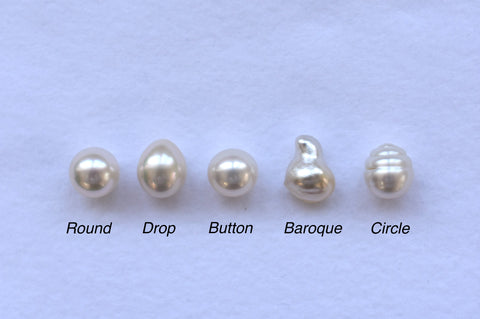
| Shape | Mostly round | Round, oval, button, baroque |
| Colors | White with pink, silver or cream overtones | White, pink, peach, lavender |
| Luster | Sharp, mirror-like | Soft, glowing |
| Price | Higher | More affordable |
Luster and look
Akoya pearls have a crisp, mirror-like shine, and more of them come out round. For generations, Japanese women have worn a matched white Akoya strand to formal events for that reason.
Freshwater pearls have a softer, satiny glow and come in many more shapes and natural colors. No two baroque or oval pearls match, and that irregular shape looks good with a sweater or a plain white shirt.

Durability
A freshwater pearl is nacre almost all the way through. A scratch won't expose a bead underneath, so you can wear freshwater pearls every day. Akoya pearls last for decades too. Their nacre sits over a bead, so store them apart from harder jewelry that could scratch them.
Whichever you choose, put pearls on last, wipe them with a soft cloth after wearing, and keep them away from perfume and hairspray. Our jewelry care guide has the details.
Price
An Akoya pearl costs more than a freshwater pearl of the same size. Each oyster yields one or two pearls, and someone has to sort through many of them to match a round, high-luster strand. With freshwater pearls, the same budget buys you larger pearls or a fuller design.
Choosing between them
For ceremonies, funerals and formal events: a classic white Akoya strand is the safe, traditional choice.
For everyday wear and layering: freshwater pearls are light, durable and easy to style with knitwear, shirts or denim.
For a modern or one-of-a-kind look: baroque and oval freshwater pearls, or a choker, show off shape and movement.
For a first piece on a budget: freshwater pearls get you a real pearl piece without stretching your budget.
The pearls we use at Pearlish
We design pearl jewelry in Kobe for the way people dress today. We use freshwater pearls in most of our pieces. Their shapes and soft glow suit modern designs, from the Spiral Pearl Choker to the Pearl Dot collection. For a classic Akoya look, see the Floating Akoya Necklace.
For South Sea, Tahitian and Mabe pearls, see our full guide to pearl types.

Shop the look
 Floating Akoya Necklace7.5mm Akoya pearl, 18K gold chain¥61,600
 Fancy Pearl Necklace Short6–10mm freshwater pearls, 40cm¥84,700
 Spiral Pearl Choker90+ graduated freshwater pearls¥88,000
 Ribbon Baroque Pearl Necklacelarge baroque freshwater pearls¥64,900